One Question for a Living-Room Film Discussion
A one-question living-room film discussion helps guests share specific observations without turning the evening into a quiz, review panel or test of expertise.
“Which moment stayed with you after the film ended?” is a useful starting point for a one-question living-room film discussion. It invites a memory rather than a verdict, so a guest can answer with a glance, a sound, a line of dialogue or an impression they cannot quite explain.
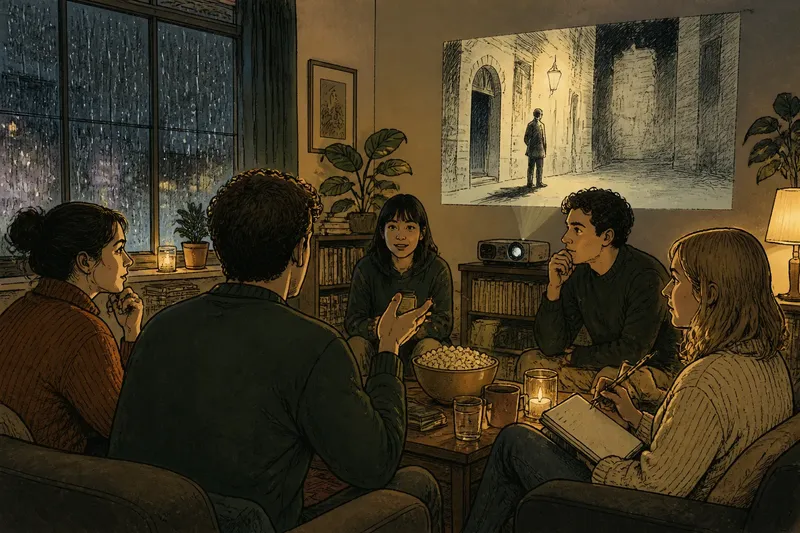
Say you invite four friends to watch a film at your flat on a rainy evening. One keeps a notebook, another rarely watches films outside the cinema, and two simply want a pleasant night in. You choose one open-ended question, make it clear that conversation is optional, and let the answers shape what follows. The question gives the gathering a centre; the guests decide where it leads.
Why keep the gathering centred on one question?
A film discussion can become a quiz without anyone intending it. Questions about a director’s other work or a production detail may favour the person with the most background knowledge. Asking everyone to judge whether the film was good can create a different pressure: guests may feel expected to offer a polished review.
One generous question changes the task. Each person can share an observation and, if they wish, say why it caught their attention. Someone might mention a pause before a character speaks; another might remember a train passing beneath a quiet conversation. The discussion begins with what people noticed, then can move towards interpretation.
The question should be open enough for different answers, but specific enough to give people a foothold. “What did you think?” can sound like a request for a full review. “Which moment stayed with you?” invites a more focused memory without prescribing whether it must involve a character, image, performance or mood.
How can you set a relaxed tone?
Send the chosen question with the invitation, but do not ask guests to prepare a speech or watch for particular themes. Before the film, make the welcome informal: put out tea or water and explain that anyone who wants to can stay for a short conversation afterwards.
After the film, allow a little quiet before asking. You might say, “I’m curious which moment stayed with you, if one did.” The words “if one did” make it easier for someone to pass or take time to think.
As host, avoid answering first simply to fill the silence. If you do share a response, keep it brief and personal: “I keep thinking about the scene where the kitchen goes quiet.” Then leave space. A short answer is an opening, not a standard everyone else has to match.
What should you do when answers differ?
In the imagined gathering, one friend mentions a character waiting outside a doorway; another remembers the lamp in that scene. The answers do not contradict each other. They show that people noticed different details, much as two people can look at the same table and notice different objects.
Listen to the detail each person offers. A gentle follow-up such as “What made that part linger?” can invite someone to say more, but it should not feel like cross-examination. If a guest gives a short answer, accept it; silence does not need to be filled with another prompt.
If one person dominates, acknowledge their thought and make room for others: “That’s a helpful observation. I’d like to hear what anyone else noticed, too.” If the conversation turns into a plot-recall contest, bring it back to experience by asking what a detail drew someone’s attention towards.
Disagreement can be useful when it grows from what people saw. One guest may read a character’s silence as anger, while another sees embarrassment. There is no need to decide which interpretation wins. Ask what each person noticed in the performance or scene, then let both readings stand.
How do you choose one question for the film?
Choose just one of these alternatives before the gathering. They are substitutes, not a sequence to ask guests in turn. Each gives the conversation a slightly different starting point while leaving room for unplanned replies.
Which moment stayed with you?
This suits many kinds of film because a “moment” can be a full scene, a passing expression or a sound. It asks for a memory first, so a guest can explain its significance in their own terms.
What did you notice after the film had settled?
This suits a quiet or ambiguous film when an impression may take time to form. Guests can still answer with a small, concrete detail rather than a complete interpretation.
Which character’s point of view felt closest to you?
This opens a conversation about identification and distance without asking anyone to approve of a character’s choices. A viewer might feel close to a character in one scene and distant from them in another.
What sound or image do you still remember?
This offers a sensory starting point for guests who would rather describe a detail than give a broad opinion. A remembered sound or image can lead naturally to talk about mood or attention.
What if a guest has no answer?
A guest may say that nothing in particular stayed with them. That is a complete response, not a failure to join in. Acknowledge it and move on, or offer one gentle prompt, such as whether a moment felt especially quiet, funny or surprising. If they still have nothing to add, leave it there.
Someone else may struggle to describe an impression. A prompt about a scene’s setting, sound or pace can help them find words, but avoid supplying an interpretation for them. An unfinished thought can remain unfinished.
If the group is hesitant, the host can share one specific observation after a pause, then stop. Conversation is like passing a bowl of sweets: setting it within reach is an invitation, not an instruction to take one.
When is the conversation ready to end?
In the imagined gathering, the friends begin with the doorway and the lamp, then turn to the character’s silence. One wonders whether the scene felt tense because of what was left unsaid; another remembers the room’s sound more strongly than the dialogue. The host listens, asks one follow-up about the remembered moment and leaves the different impressions unresolved.
When comments drift away from the film, the discussion can rest. The host might say, “I’m glad I heard what each of you held on to,” then offer tea or change the subject. Nobody needs to announce a final interpretation, rank the performances or name a favourite scene.
The aim of a one-question living-room film discussion is not to produce a shared reading. Guests can leave with their own response and perhaps one new detail to consider. Choose a question people can answer from memory, keep participation optional, and let the conversation end when the group is ready.